
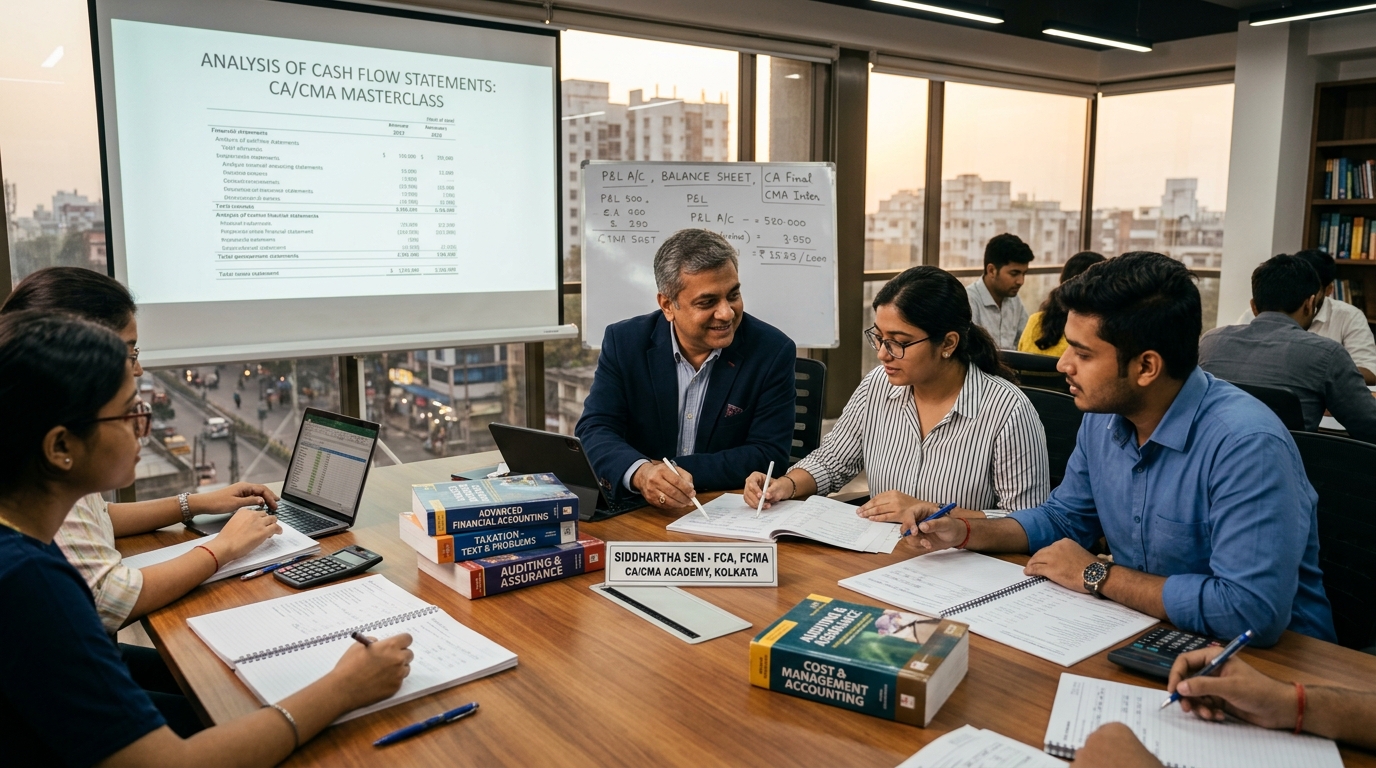
CA Final preparation requires more than completing the syllabus. Students need advanced conceptual understanding, regular question practice, repeated revision, examination-oriented testing, and a study routine that remains consistent over several months. For students searching for CA Final offline classes in Kolkata, classroom coaching can provide the structure and discipline needed to manage this demanding stage more effectively.
Offline learning continues to be relevant because many students find it easier to stay focused when they have fixed class timings, face-to-face faculty interaction, and a dedicated academic environment. Recorded and online courses provide flexibility, but that flexibility can sometimes lead to postponed lectures, growing backlogs, and inconsistent preparation. Classroom learning can reduce some of these problems by creating a regular schedule that students are expected to follow.
Under the current ICAI Final structure, students prepare six papers: Financial Reporting, Advanced Financial Management, Advanced Auditing, Assurance and Professional Ethics, Direct Tax Laws and International Taxation, Indirect Tax Laws, and Integrated Business Solutions. These papers require very different preparation methods, which means students looking for CA Final offline classes in Kolkata should evaluate the faculty and teaching approach separately for each subject rather than selecting coaching only on the basis of institute popularity.
One of the biggest academic advantages of offline classes is direct concept-based teaching. At CA Final, students cannot depend only on memorising formats, provisions, formulas, or previously solved questions. They need to understand why a particular accounting treatment is required, why a financial calculation works in a certain way, how a tax provision applies, and how professional concepts should be presented in the examination.
Financial Reporting, for example, requires advanced understanding and application. ICAI's current November 2026 revision programme includes focused Financial Reporting sessions on areas such as accounting and reporting of financial instruments. A good offline class should help students understand such technical areas step by step and then provide enough practice for students to handle questions independently.
Advanced Financial Management also requires strong conceptual and numerical preparation. Students need to understand financial models, formula logic, calculations, and analytical applications. ICAI's current revision classes include Portfolio Management among the topics for Advanced Financial Management. Classroom teaching can be valuable here because students can follow the faculty's problem-solving approach in real time and clarify difficult calculations more easily.
Advanced Auditing, Assurance and Professional Ethics requires a different learning style. Students need to understand professional concepts, use appropriate technical terminology, revise regularly, and develop the ability to reproduce important points clearly. ICAI's November 2026 revision sessions include Professional Ethics and liabilities of auditors among the focused areas. Offline teaching can help students understand difficult audit concepts, but classroom explanation still needs to be followed by independent recall and writing practice.
Direct Tax Laws and International Taxation require careful attention to provisions, amendments, computations, and examination-attempt applicability. Indirect Tax Laws also requires students to understand GST-related concepts and apply them accurately. Students selecting CA Final classroom coaching in Kolkata should therefore confirm that the course material is relevant to their specific examination attempt and that current updates are properly incorporated.
Integrated Business Solutions requires yet another approach because it is a multidisciplinary case-study paper. ICAI identifies Paper 6 as Integrated Business Solutions (Multidisciplinary Case Study with Strategic Management). Students need to connect different areas of knowledge and apply them to business situations. This means classroom discussions, case analysis, and application-oriented teaching can be more useful than simple note memorisation.
Another important reason students choose CA Final offline coaching classes in Kolkata is discipline. CA Final preparation can become difficult when students study entirely according to convenience. A few delayed lectures can quickly turn into a large backlog. Offline classes create a timetable that students have to follow, helping them maintain academic continuity.
However, attendance should not be confused with preparation. A student may attend every offline class and still remain underprepared if there is no regular self-study outside the classroom. CA Final coaching should support preparation, not replace it.
A practical preparation cycle should be
Classroom Learning → Independent Practice → Revision → Testing → Error Analysis
This process helps students convert what they learn in class into actual examination ability.
Question practice is especially important in practical papers. Students often feel confident after watching the faculty solve an advanced question, but the real difficulty appears when they attempt a different question independently. Students should therefore use classroom lectures to understand the approach and then solve questions without immediately referring to the faculty's solution.
Mistakes should also be analysed properly. A wrong answer may result from a conceptual misunderstanding, calculation error, missed adjustment, incorrect interpretation, or poor time management. Identifying the reason is more useful than simply correcting the final number.
Revision is another major area where offline students need discipline. Classroom batches continue moving forward, so students can easily focus only on new chapters while forgetting earlier ones. A strong revision routine should therefore run alongside regular classes.
Students can use weekly revision to revisit completed topics, cumulative revision to connect older chapters with newer ones, and final revision to focus on weak concepts, important questions, amendments, and frequently repeated mistakes.
ICAI's own preparation support demonstrates the importance of revision and testing. The Institute currently provides Live Virtual Revisionary Classes for students appearing in the November 2026 Final examination and has also announced Live Virtual Classes for May and November 2027 attempts. Students can use official ICAI resources alongside their classroom coaching to strengthen preparation.
Mock testing is also important. ICAI conducted two Mock Test Paper series for CA Final students appearing in May 2026, covering the Final papers in physical and virtual modes. This reinforces an important point: CA Final preparation should eventually move from learning to performance under examination conditions.
Offline coaching can be particularly valuable for students who need direct interaction. In a classroom, students may find it easier to ask questions, observe how the faculty approaches difficult problems, and stay engaged throughout the lecture. However, students should verify how doubt support actually works rather than assuming that physical attendance guarantees unlimited faculty access.
The classroom environment can also reduce distractions. Students studying at home may have to deal with mobile phones, social media, family interruptions, or the temptation to pause lectures repeatedly. A physical classroom creates a dedicated study environment where the student can focus on one subject for a fixed period.
At the same time, offline learning has one major cost that students should not ignore: travel.
A three-hour classroom lecture may actually require five hours if commuting takes one hour each way. That additional time reduces the hours available for question practice, revision, other CA Final subjects, rest, and personal responsibilities.
Students searching for CA Final offline classes in Kolkata should therefore calculate the total door-to-door commitment before joining a batch. Location can make a significant difference when classes need to be attended several times every week.
Students commonly search for coaching around areas such as CR Avenue, Chittaranjan Avenue, MG Road, Girish Park, Central Kolkata, and North Kolkata because these locations can be accessible through metro, train, bus, and other public transport. A conveniently located coaching centre can reduce unnecessary commuting and make consistent attendance easier.
However, location should remain a secondary factor. Students should not select a weak academic option simply because it is nearby.
A more sensible priority is
Faculty → Subject Expertise → Conceptual Teaching → Question Practice → Revision → Doubt Support → Schedule → Location
The nearest classroom is not automatically the right classroom.
Students should also check the batch schedule carefully. CA Final students need considerable time outside class. A timetable packed with long coaching sessions every day can become counterproductive if the student has no time left to practise or revise.
The best offline preparation structure should leave enough time for
- Classroom lectures
- Independent question-solving
- Theory recall
- Revision
- Mock tests
- Amendment updates
- Weak-area correction
- Rest and recovery
A student who spends every available hour attending lectures may complete the course but still struggle to revise it effectively.
Students should also evaluate CA Final offline classes fees in Kolkata carefully. Price is important, but it should be compared with the full academic offering. Before paying, students should check the faculty, subject coverage, examination attempt, study material, revision support, doubt support, testing, and class schedule.
The cheapest class may not provide the academic support a student needs. At the same time, a higher fee does not automatically guarantee better teaching. The correct question is whether the class offers good value for the student's specific preparation requirements.
Another common mistake is joining multiple offline and online courses for the same paper. Students sometimes believe that collecting more faculty notes or classes will strengthen preparation. In reality, this can increase duplication and reduce revision time. At CA Final, completing and repeatedly revising a dependable core resource is often more useful than constantly changing faculty or material.
Students considering offline coaching should also check what happens when they miss a lecture. Practical training, illness, travel, or other responsibilities can occasionally interfere with attendance. Before enrolling, students should ask whether backup lectures, recordings, notes, or another recovery system are available.
A strong offline learning routine can be simple. Before class, briefly review the previous lecture. During class, focus on understanding the concept rather than mechanically copying everything. After class, revise the topic and attempt relevant questions or active recall. At the end of the week, revisit earlier chapters and track unresolved weaknesses.
This creates continuity between classroom learning and independent preparation.
Students exploring Abhimanyyu Agarrwal Classes while searching for CA Final offline preparation should review the official website, faculty information, course listings, free resources, and contact details. Because the current publicly indexed information does not establish that every CA Final paper is offered as an offline course, students should verify the availability of the specific CA Final subject directly before enrolling.
Students should confirm
- Required CA Final paper
- Faculty
- Current offline batch
- Examination attempt
- Class schedule
- Fees
- Study material
- Revision support
- Doubt support
- Backup class policy
This avoids making a decision based on outdated or assumed course information.
The real benefit of offline coaching should be greater structure, not greater dependency. Faculty can explain difficult concepts, demonstrate applications, clarify doubts, and guide examination strategy, but students still need to practise, revise, test, and improve independently.
Conclusion:
CA Final offline classes in Kolkata can provide a structured and disciplined preparation environment for students who prefer face-to-face teaching, fixed schedules, classroom interaction, and regular academic continuity. With six advanced papers including Financial Reporting, Advanced Financial Management, Audit, Direct Tax, Indirect Tax, and Integrated Business Solutions, students need subject-specific teaching along with independent practice, continuous revision, and examination-oriented testing. Classroom students should also consider travel time, batch schedules, fees, and the amount of self-study time available outside lectures. Those exploring Abhimanyyu Agarrwal Classes should verify the current availability of the required CA Final offline subject directly from the official website or institute before enrolling. The right offline coaching should ultimately help students move beyond classroom attendance and develop the ability to understand, apply, revise, test, and perform independently in the CA Final examination.
Free CA & CMA 2026 Revision Strategy Kit
Download comprehensive chapter-wise formula sheets, accounting adjustments checklists, RTP & MTP solutions, and past ranker answer copies prepared by CA CMA Abhimanyyu Agarrwal.